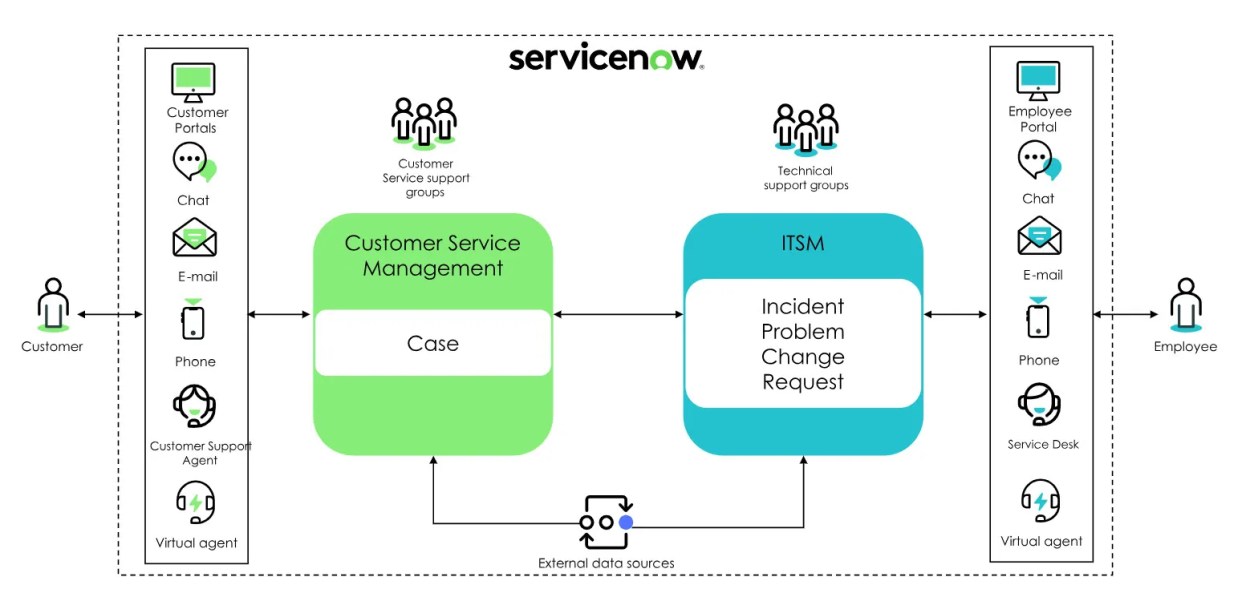
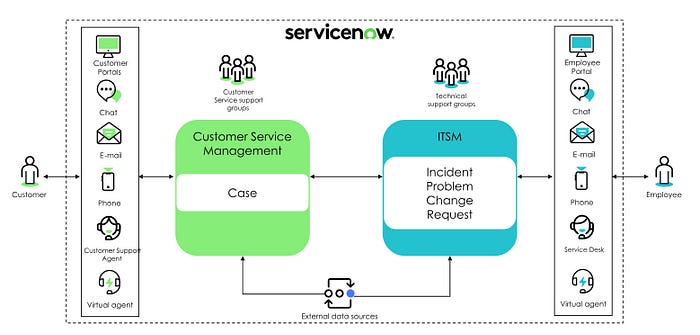
ServiceNow’s CSM and ITSM products are both incredible products by themselves, but put them together and you actually get quite a dynamite delivery package.
I knew that technically, the products were very similar (they share a lot of the same tables, etc) but taking a closer look you will see that the use cases for the applications are quite different. The critical differences being around the key stakeholders and their goals.
But first, let’s review the products.
The Basics: ITSM
- Typically focuses on an organization and the internal employees of that organization (aka: internal focus on delivery)
- Typically will “set the system up” (ex: catalog requests, SLA’s for response, incident response, etc) and processes up that are specific to the organizations goals and values (the goal is to serve the business and employees)
The Basics: CSM
- Typically will focus on external customers who are not part of the organization (aka: external focus on delivery)
- Typically will “set the system up” so that the process is centered on providing the best service to the external customer before-during-after a purchase / service delivered (the goal being to increase a sale, customer satisfaction, retain customers)
In an earlier post I mentioned that sometimes people don’t see the difference between IT for IT and IT for business, when there is a very big difference.

Specifically, the key difference is the stakeholders. For CSM, the key stakeholders are true core business people.
Examples of CSM stakeholders:
- Customer service agents, managers and executives
- Sales managers
- Account managers
- Portfolio managers
- Other business department managers (ex: finance, procurement, etc)
Examples of ITSM stakeholders:
- Technical response staff (help desk support)/agents
- Developers
- System admins
- IT Security leadership
- IT executives/managers
- Engineers
Luckily, for a lot of businesses who have a need to provide both IT and customer service, CSM and ITSM integrate seamlessly to provide a full picture offering (“in a single pane”) for specific business models.
The best scenario to use both ITSM and CSM together, is when you need to provide support for a product or service sold. For example, you sell custom software development and provide on-going customer support for the product on a subscription basis. Another example might be for a mobile phone service + support for the phone, billing, etc. Think of the 2 products as able to offer a B2B, a B2C and/or combination of B2B-(to-external customers)B2C.
Other product examples from Servicenow —
IT infrastructure products:
- Physical goods: routers, computers, servers, etc.
- Digital goods: operating systems, on-premise software, etc.
- Services: virtualized servers, network security, managed print services, cloud services, Software-as-a-Services (SaaS), Platform-as-a-Service (PaaS), etc.
Non-IT infrastructure products:
- Physical goods: electronic book reader, Automated Teller Machine (ATM), etc.
- Digital goods: mobile banking app, customer insurance self-service portal, etc.
- Services: TV streaming service, car Global Positioning System (GPS), etc.
So, how does it all come together?
CSM and ITSM integration where it matters: incident, problem, change and request.
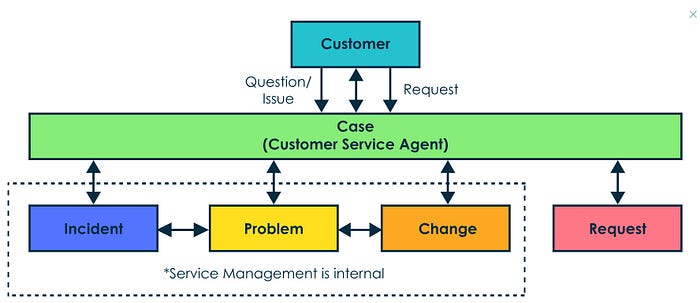
- Customer (external) can submit a case (aka a request) via the CSM portal
- Support agents can then open the case(request) and immediately open a change, incident, problem or another request directly from the case (and it logs it)
- If there are existing records (incident, problems, changes, requests, etc) agents can associate or disassociate records to the case; if the associated record is updated, the case notes are also automatically updated
- Managers have access to the CSM dashboards for analytics
Example of seamless integration: if I (as a customer) subscribe to a TV streaming service and it goes offline, I call and open a case (“hey, there is a issue, help me”) — the point here is you get a case opened.
The customer service agent who receives the case (or opens it for me) can also then open an incident immediately from the case, which is assigned automatically to the backend IT team.
Then, the IT team checks it out and identifies there is an issue (“they see a router is down”) — they fix it. The IT team then updates the incident notes and closes the incident.
The original case notes are automatically updated, the agent gets the update and (if manually configured) closes the case, which then sends me (the customer) a survey about if I am satisfied.
As you can see, for the correct business model, the power of using both ITSM and CSM creates agility across enterprise departments that were once siloed. It provides instant support to a customer, cross-department communication with ease (think of the notes back and forth between IT and CSM agents and you can even comment to the external customer if needed), instant visibility into state/status for managers and we can’t forget the end-to-end reporting that is available out-of-the-box for leadership.
*Note: since it’s my job, I must state that you NEVER want to customize ITSM to be like CSM or vice versus. Just pay for the right product, the overhead from technical debt will eat you alive. Seriously. Not to mention the unhappy business users because it’s going to break quite a bit.
.
Discover more from Julia's Dev
Subscribe to get the latest posts sent to your email.
 Julia's Dev