Recent incidents, such as the surge in electronic waste during the COVID-19 pandemic and the fallout from improper recycling practices revealed in tech industry exposés, have underscored the urgency of effective asset disposal lifecycle management. These events highlight the pressing need for businesses to adopt software tracking methods, like those offered in ServiceNow’s Hardware Asset Management, to manage their hardware’s end-of-life responsibly.
Let’s review how real world companies currently utilize sustainable practices in managing hardware assets and how software, such as Servicenow’s Hardware Asset Management, can be leveraged to complete the lifecycle tracking and repoting process.

Technology Hardware Asset Management: How to Stop Being “The Black Sheep” of the World
Let’s face it: the devices that power the world are not exactly the most eco-friendly products to dispose of. Many hardware assets, from technologically driven large manufacturing robots or machines down to laptops, often contain parts that are not great for the environment – especially if they are not disposed of correctly. As it turns out (thank you watchdog groups) we aren’t so great at disposing IT hardware assets consistently or correctly. In some cases, the old assets were directly dumped, off the African coast, directly into the ocean (wth? – officially this has stopped – but I doubt it really has).
As generations of people grow up, and more education becomes available, expectations are changing. ESG initiatives are growing, countries are pledging sustainability promises – we are making moves to stop treating the planet like an unlimited resource, and dumping ground, for consumerism.
So, what are some common practices and methods that support the sustainability initiatives to clean up the IT Asset reputation?
Common practices for sustainable asset management include (but are not limited to):
- Manufacturing take-back programs (Vendor Credit): Some technology manufacturers offer take-back programs, where corporations can return their used electronics directly to the manufacturer for recycling or safe disposal. This not only ensures that the equipment is disposed of responsibly but also helps manufacturers reclaim valuable materials for reuse.
Real world example: HP’s Planet Partners Program: HP’s recycling program allows customers to return used products and supplies for free recycling, aiming to recover plastics and metals for new HP products. This is part of HP’s broader sustainability goals, including achieving zero waste in its operations and driving towards a circular economy.
- Recycling: Specialized recycling companies are capable of extracting valuable materials from obsolete hardware, such as gold, silver, and copper from circuit boards, and plastics that can be re-used in other products. This process not only reduces the amount of waste going to landfills but also conserves resources.
Real world example: Apple’s Recycling Program – Apple has been a pioneer in recycling and materials recovery, introducing robots like “Liam” and “Daisy” that disassemble iPhones to recover valuable materials. This initiative is part of Apple’s goal to eventually make all of its products from recycled or renewable materials, addressing the environmental impact of electronic waste.
- Upcycling and Re-purposing: –Organizations are increasingly looking into re-purposing and upcycling old hardware to extend its lifecycle. This could mean using outdated laptops for less resource-intensive tasks or transforming old smartphones into security cameras or digital signage.
Real world example: Upcycling in Education – Schools and universities often repurpose old computers for use in computer labs or libraries. For example, a university may take outdated desktops and install lightweight Linux distributions on them to serve as web browsing stations or word processing terminals for students, effectively extending the hardware’s useful life.
- Donation to extend utility: Many businesses and institutions donate outdated but functional hardware to schools, non-profits, and developing countries. This not only extends the asset’s lifecycle but also supports digital inclusion and educational initiatives.
Real world example: World Computer Exchange – The World Computer Exchange is a non-profit organization that helps to extend the lifecycle of used computers by donating them to schools, libraries, and community centers in developing countries. This not only reduces e-waste but also supports educational and development goals in less affluent regions.
- Reselling: Many times a business may no longer need the hardware, so they re-sell the product to another company that may need it.
In addiiton to these common business practices, there are global organizations that provide guidance, suggested standards and practices for sustainable asset practices (amongst other things):
- ISO 14001: This is an international standard that specifies requirements for an effective environmental management system (EMS). It provides a framework that an organization can follow, rather than establishing environmental performance requirements. It is applicable to any organization, regardless of size, type, and nature.
- Electronic Product Environmental Assessment Tool (EPEAT): EPEAT is a globally recognized environmental rating system for electronic products, which helps purchasers evaluate, compare, and select electronic products based on their environmental attributes. The system considers the entire product lifecycle, including energy efficiency, reduction of hazardous substances, and product longevity.
- Energy Star: Managed by the U.S. Environmental Protection Agency and the U.S. Department of Energy, Energy Star is an international standard for energy-efficient consumer products. Devices carrying the Energy Star service mark generally use 20%–30% less energy than required by federal standards.
The Quiet Giant for Sustainable Asset Management: ServiceNow’s HAM
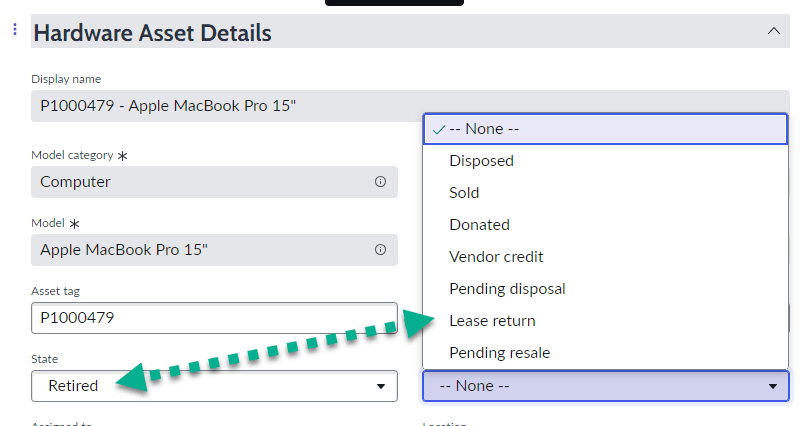
ServiceNow’s Hardware Asset Management application comes equipped, right out-of-the-box, to help manage, track and identify the exact location and state that the asset in question is. The application contains the ability to even automate the process by using flows – and has a ready to use “asset retirement” option.
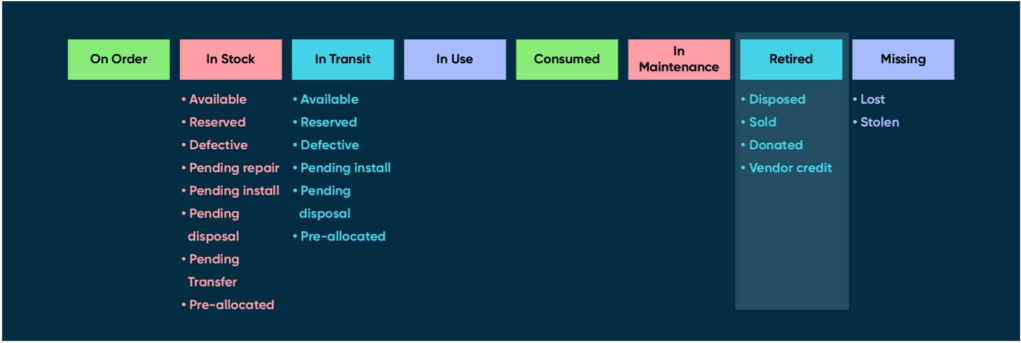
HAM uses an industry standard asset lifecycle, and the key to the disposal state, retired, is in selecting the substate. Why? Because you are tracking what became of the asset. Also, there are normally regulations (external or internal) that control certain types of asset retirement.
Some of the out-of-the-box asset substate’s (supporting common sustainability practices) are Disposed, Sold, Donated, Vendor Credit, Pending Disposal and Pending Resale.
Note: try not to add to these states, but I can see a case/discussion to track for ‘Recycled’ that is outside a ‘Vendor Credit’ or ‘Disposed’ option
Workspace Sample View:
As IT teams support the entire hardware asset lifecycle from procurement (on order) to retired (disposal), using software such as ServiceNow’s HAM, creates visibility that was not there before. It is already in alignment with tracking (and reporting on) IT hardware asset disposal sustainability practices.
Show Me the Proof
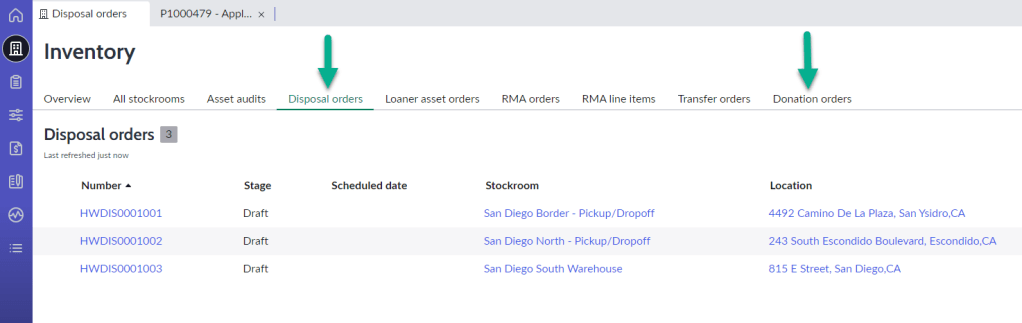
Manager’s can log in and go to the Hardware Asset Management workspace and see exactly where their assets are, track how they will retire them, and easily remain in compliance with any legal disposal asset requirements or vendor required sustainability process requirements for reporting.
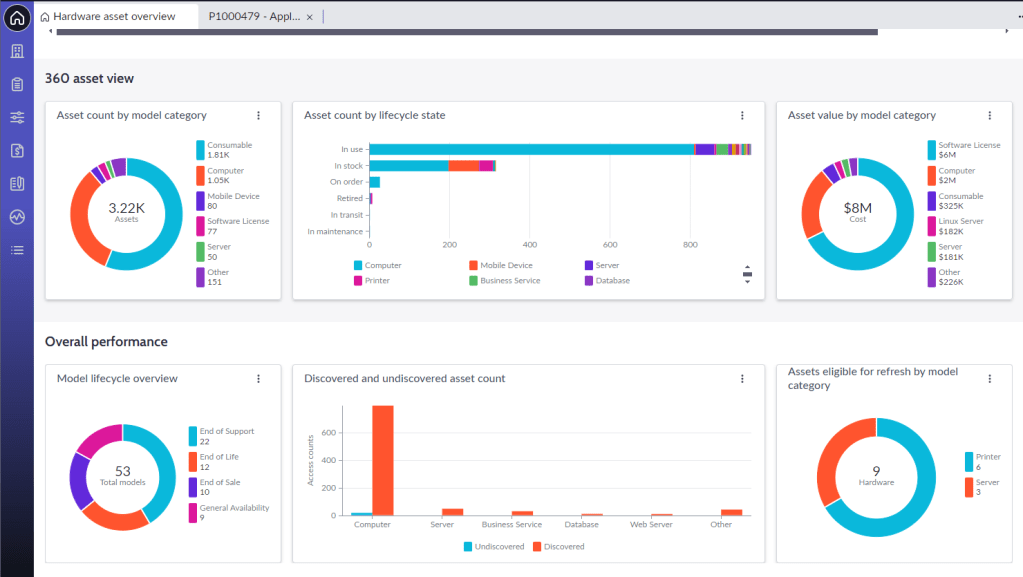
They are able to track Inventory and see the disposal orders and donation orders:
What Happened to my Dashboard?
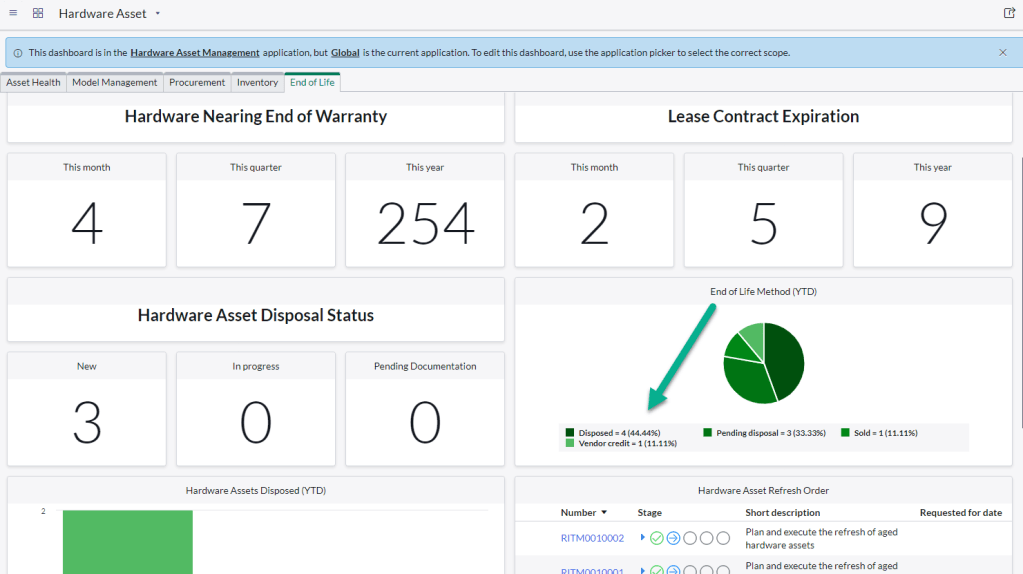
Don’t worry, it’s there. Manager’s and users can access the ‘Hardware Asset Management’ dashboard and see ‘End of Life’ assets coming.
Note that you can see the ‘End of Life Method’ widget – and it shows the substates and the percent (%) of your total inventory counts. So if you had a goal to donate 20% of your retired assets, the widget is right there and you can quickly see if you are at your goal yet.
Note: If you have ITSM + HAM Pro, you should use CIM and track your goal – my point is that the widget has a fast visual for the % of retired/donated assets
Let’s Summarize:
Servicenow’s Hardware Asset Management product is the perfect example for any business looking to:
- Follow industry standards for asset management lifecycle
- Track and discuss initatives for Green and Sustainable practices
- Report on how the business is helping to shrink their “bad” footprint
- Discuss how their disposal tracking meetings audit requirements
- Prove the value of recycling, upcycling or participating in green programs related to hardware assets
- Automate retirement (and potentially reclaimation) processes out of the box
- Generally make the world a better place, even if it just seems like 1 tiny step in that direction
Embracing sustainable lifecycle practices in IT asset management not only supports environmental stewardship but also promotes economic efficiency and organizational resilience.
Utilizing ServiceNow’s Hardware Asset Management product can be a game-changer in this endeavor, offering a comprehensive solution that aligns with sustainability goals while optimizing asset utilization.
By leveraging its robust features, organizations can ensure a more sustainable, cost-effective, and responsible approach to IT asset management.
Further reading:
- Oxford: Environmental impact of IT: desktops, laptops and screens
- MIT: The Staggering Ecological Impacts of Computation and the Cloud
- Earth.org: The Environmental Impact of Broken Technology and the Right to Repair Movement
Discover more from Julia's Dev
Subscribe to get the latest posts sent to your email.
 Julia's Dev