
Navigating a digital transformation is a complex endeavor, but ServiceNow’s readiness checklists, for both technical and process setup(s), offer a strategic advantage. These expertly crafted “readiness checklists” ensure that every crucial detail is accounted for, paving the way for a smooth and successful transformation.

To Begin, Begin. But first….
The first crucial step in successfully implementing ServiceNow is what I like to call a “pre-pre-implementation” task. Note: ServiceNow does state this step in their training course.
Before engaging with any implementation partner, it is essential to identify key department stakeholders and managers. These individuals must complete the appropriate foundational courses from NOW Learning. This training will provide them with a comprehensive understanding of how the system is designed to function.
In many cases, on your implementation you will utilize a “train-the-trainer” approach, making these materials invaluable for your internal team as they subsequently train others. Often, the insights and information provided in these courses are not available elsewhere.
For employees undertaking these courses: set aside your existing processes and preconceived notions of how you want the system to operate. Focus solely on understanding how ServiceNow is designed to work.
If you are not well-versed in how the system is supposed to function and proceed to gather requirements, you risk customizing the platform to mirror your old system without considering necessary process improvements.
Embracing this change is the essence of adopting an enterprise platform for digital automation. It is about leveraging the platform’s capabilities to enhance and transform your business processes.
Let’s talk Process
Did you know that ServiceNow offers over 25 readiness checklists? Each checklist provides a specific “order of operations” to ensure you are fully prepared to proceed with your technical transformation.
ServiceNow is committed to the success of your digital transformation. However, many essential products and processes designed to set you up for success are often overlooked. These should be a top priority for your C-Suite, especially if they aim to implement new features like GenAI.
Ok, so where do I begin?
After your key stakeholders take/have access to the specified NOW Learning courses for your chosen products — there are (2) types of checklists available from ServiceNow:
- 1) Process / OCM / Operational (it depends on what you call this at your business)
- 2) Technical Readiness – related to the literal technical environment
Practitioner Note: always follow the recommended ServiceNow ‘Project Success’ guide for implementation lifecycle on NOW Create. This blog highlights pieces – from my own experience with many accounts post-implementation – that are often not used, overlooked or discarded as not important.
Often, these are actually items I end up either re-implementing or re-visiting with the client, POST implementation. And then of course we re-do the existing setup correctly. Be honest – what a total waste of time! So, let’s do it the right way from the beginning.
“Wenn schon, denn schon.”
Pre-Implementation Process Checklists
1. Before you start ANY type of development or technical setup of anything, read the “Assess if my organization is ready for ServiceNow” success guide and send your Pre-Implementation Readiness Survey to employees.
- Pre-Implementation Benchmark Survey – template
ServiceNow states: “Use to gauge user readiness and awareness of the forthcoming changes and to assess user experience with previous changes at the company with regard to frequency and effectiveness of communications, training, sponsorship, and support.”
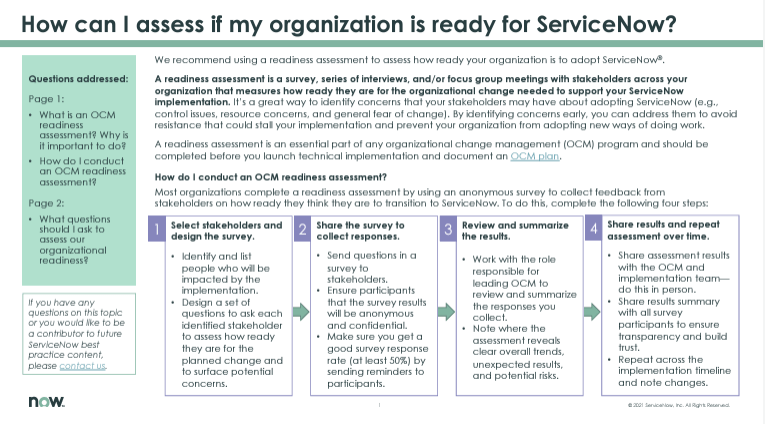
MAKE SURE that your C-Suite sees the results of these surveys. If the majority of people do not want to change, then your C-Suite involvement will increase substantially or they may want to wait on implementing.
2. The next step is to identify and focus on key employees and how they will fit into your transformation. To do this, you use the ‘Talent Development – Customer readiness checklist”
The key items in this document are the steps on slide 6. Prepare your organization’s skills and job architecture
• Understand your organization’s current skills and job architecture state, and document it. This will help you learn where you are on your maturity journey and if you need to implement Talent Development in a phased approach.
• If you have the resources, work with your internal teams or a partner to create a skills strategy and framework and update your job architecture.
You will not realize the full ROI on this costly platform if you lack the correct resources, the right skill sets, and the willingness to commit to the work. I cannot stress this enough: you must carefully consider resource allocation before initiating any setup.
Create an accountability role chart and assign specific individuals, and teams, to the corresponding roles and personas within the module. This deliberate approach is essential for successful implementation and achieving your desired outcomes by holding teams and individuals accountable for changing.
Failure is inevitable if you neglect this crucial step. For those who claim, “We never did that, and it worked,” understand that merely making something “work” is part of the problem. The goal is to demonstrate that the ROI of the platform – that it improves the process, improves the KPI’s, improves self-service, reduces overhead costs and solves problems with the existing setup.
Simply carving out a tiny piece of 14 modules and saying, “Yeah, this works,” is fundamentally flawed. With this mindset, you will not achieve significant ROI. The focus should be on a deliberate, comprehensive implementation with measurable value.
Always remember the intent of ServiceNow: to be the platform of all platforms, to be a ENTERPRISE WIDE, centralizing software. It’s not just for IT anymore, it’s no longer “just a ticketing system”. The “mindset” has changed.
Technical Readiness :: Planning Next Steps

Once you have your pre-implementation readiness checklists complete, you are ready to start looking at the technical readiness checklists. As mentioned before, there are over 25+ checklists available on the ServiceNow Success Site (scroll to the bottom) and Now Create
I am going to highlight the platform items, but please use the appropriate ‘Readiness Guide’ for your product/platform.
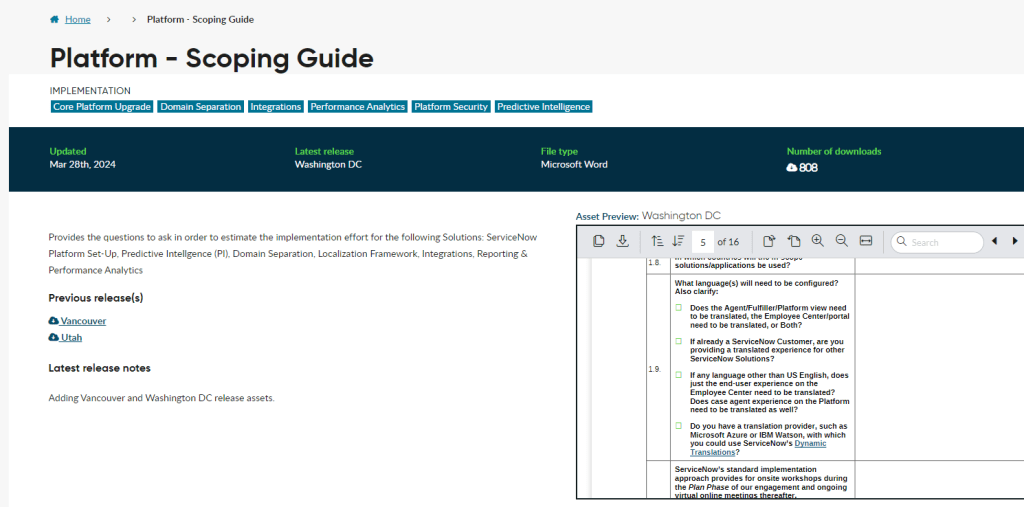
DO NOT BUILD ANYTHING YET. You are still planning. - Start with the foundation. Use the Platform Questionnaire and the Platform Scoping Guide to quickly get a firm grip on where you are and what needs to be done in order to be ‘Platform Ready’ for actually setting it up. Try to get these items documented before meeting with a partner and give these items to the partner. This will speed up the “Initiation and design” process immensely.
Platform Guides: Provides the questions to ask in order to estimate the implementation effort for the following Solutions: ServiceNow Platform Set-Up, Predictive Intelligence (PI), Domain Separation, Localization Framework, Integrations, Reporting & Performance Analytics
2. Begin to define your platform implementation strategy
This document will guide technical managers through how they will be setting up the platform and the next steps. This document should always “come AFTER” the Process Documents mentioned above. Follow the order of operations for implementing or you will “put the cart before the horse” and have a big mess.
Practitioner Insight: This document is immensely helpful, but is likely going to need to also involve your partner. Particularly around the roadmap items.
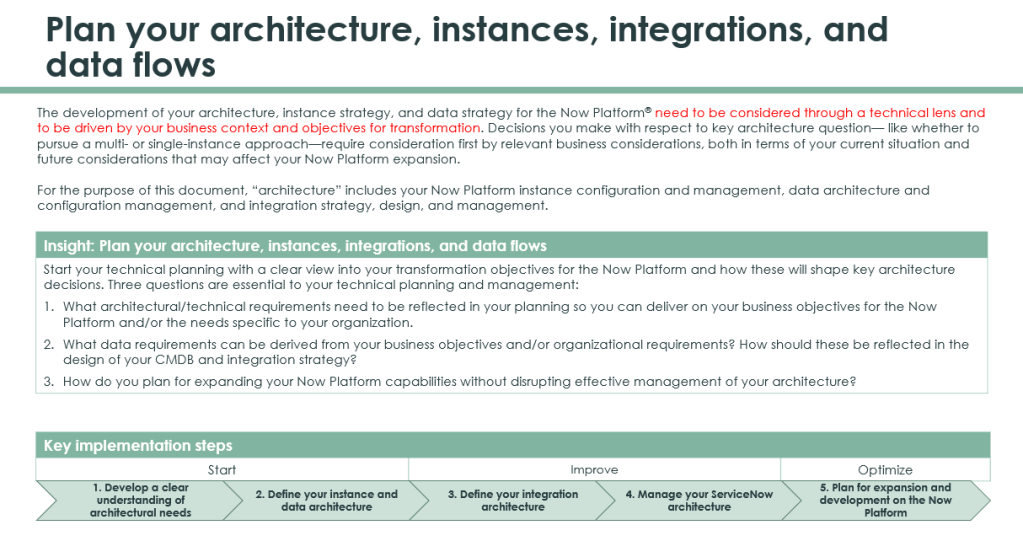
3. Plan your architecture, instances, integrations and data flows. Key word there is: PLAN.
Key takeaways for a successful implementation:
The following items summarize the key takeaways for setting your company up for a successful ServiceNow implementation.
- Identify key C-Suite executives to “lead the charge”. Ensure they are included in the “Roles and Responsibilities Accountability Matrix”.
- Send business readiness surveys: make sure before you sign up for anything, the people in your company are willing and ready to actually change their software and process. It is critical for success that middle and lower management/employees get onboard with this transformation. If there is resistance, the C-Suite needs to lead the charge on holding people accountable for changing their ways.
- Do not rush the ENTERPRISE wide implementation: Even if you use the ‘Rapid MVP Implementation’ path – be honest. It takes 8-12 months of active, hands-on involvement from your everyday business users and new “service owners” to really get a big win for adoption and see ROI. Anything less, your risk to be successful – long term – will increase substantially (in the negative direction – especially if there are multiple other projects going on, other software being implemented, etc). This type of implementation requires focus and consistent reinforcement of the new process.
- Pre-partner/workshop Training: Make sure the “key players” who will be part of the implementation, and training the other employees, take the ‘Foundations’ courses from NOW Learning prior to planning, or going to, any partner requirement workshop (Why? to avoid re-work and to digitally transform process with the new setup – be honest: how can you write out requirements without knowing how it is supposed to work in the first place?)
- Hybrid Agile will help you win: If you want to implement an Enterprise Software system, make sure you plan process first and then execute development (even if you are “agile”, do process requirement readiness documents up front – then the dev work… or don’t, and see the chaos that will ensue).
- Follow the ServiceNow implementation process, note anything that differs from the suggest process via the ‘Readiness Checklists’. Document WHY you aren’t using that step or that checkbox item.
Let’s Recap
Having a successful implementation is completely in your (C-Suite or Procurement Departments) hands. ServiceNow’s readiness checklists provide essential guidance for a successful digital transformation. They help ensure that all technical and business aspects are carefully considered, reducing risks and enhancing efficiency. Utilizing these checklists leads to smoother transitions and stronger outcomes.

Additional Resources
Process:
- NOW Value Readiness Checklists (at the bottom of the page)
- Organizational Readiness (Legacy look – content still valid)
- Pre-Implementation Readiness Assessment
- Pre-Implementation Benchmark Survey
- Platform Questionnaire
- Defining a Platform Implementation Strategy
- Platform – Scoping Guide
- Large Enterprise Implementations – Roles – Implementer Team
Additional Resources to consider:
- Operational Readiness – use this checklist once you think you are ready to go live
- Community Post – Project Readiness Checklist – I just love this post; it’s concise and hits the main areas that are missed on some planning lists
Video:
- Official ServiceNow Community YouTube Video: Choose your own adventure — ServiceNow Implementation Models
Image Source: all images are free and from FreePik.com
Discover more from Julia's Dev
Subscribe to get the latest posts sent to your email.
 Julia's Dev